
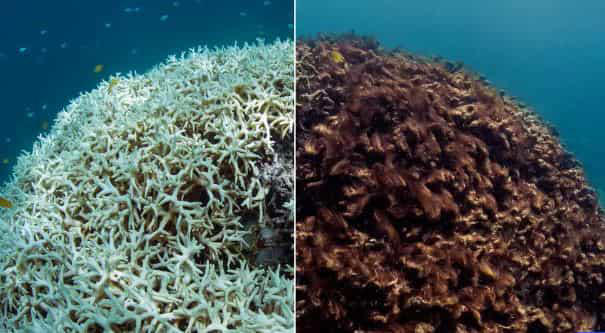
Scientists were 'horrified' after they observed that at least 97 per cent of corals on a reef in the Great Barrier Reef have died during the past months in what is being dubbed as the world's worst coral bleaching event. Scientists used drone imagery to conduct an analysis of the death of corals on a reef at Lizard Island. The experts are now calling on the Australian government to release data on coral deaths as soon as possible, especially after last summer's mass bleaching.
Bleaching is referred to as a phenomenon when corals lose their vibrant colors and turn white due to changes in temperature. Mass coral bleaching is fast emerging as a global crisis as ocean temperatures rise due to climate change and pollution.
Macquarie University marine biologist Prof Jane Williamson, who was a part of the team that studied corals on Lizard Island, said she was "horrified" after seeing the analysis.
UNESCO urges Australia to improve targets
UNESCO has assured Australia to not put the reef on the list of "in danger" sites but it cautioned Australia to improve its climate targets. “[Australia] is urged to make mortality rates public as soon as possible,” UNESCO said in a report.
Jane Williamson and the team had earlier flown the drone over the reef in March to check the intensity of bleaching and fluorescing. When the action was repeated last month, they were shocked to learn that most of the corals had died.


“At least 97% of the corals had died over those three months. We were there to do our sea cucumber monitoring work, but there was silence amongst us nine researchers," she said.
“We came out of the water and didn’t know what to say. It’s an iconic reef and most of it was dead,” she added.
Dr Lyle Vail, the director of the Australian Museum’s Lizard Island Research Station, said the development was heartbreaking.
“It’s pretty heartbreaking to lose all that coral recovery,” he said.
(With inputs from agencies)